About
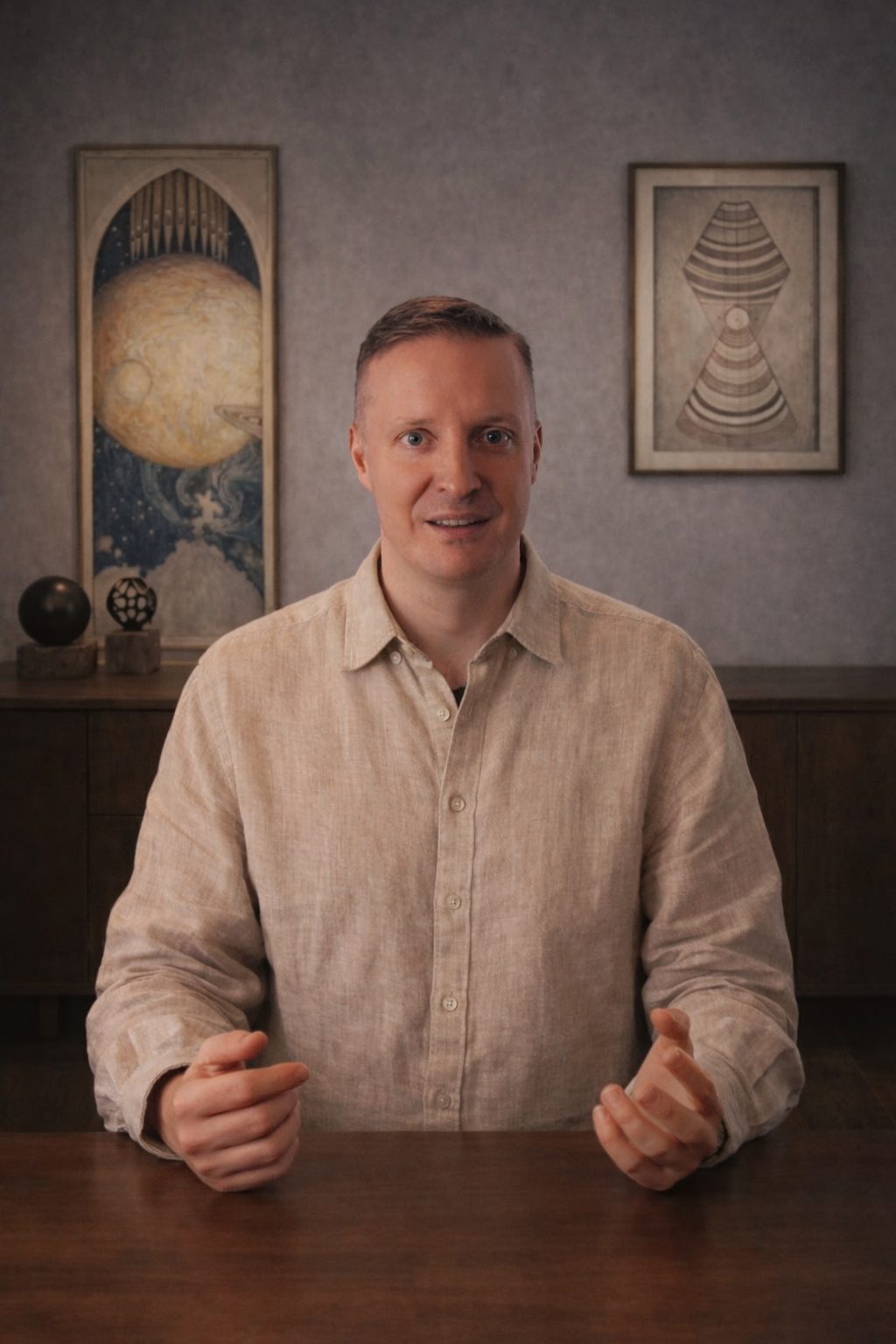
Miska Käppi
Born in Salla, north of the Arctic Circle. Spent twenty years studying wisdom traditions across four continents. Trained over 300 yoga teachers. Now mentors a small number of people into a depth of practice that is otherwise nearly impossible to find.
The story
From the Arctic Circle to the other side of the world
I was born in Salla, eastern Lapland, north of the Arctic Circle — a region where the descendants of Europe’s last nomadic peoples still herd reindeer as a living trade. My grandfather helped build Finland’s school system, but his heart belonged to the wilderness. He saw something in me and took me on my first expedition into the backcountry when I was three years old.
As a teenager, I fell in love with science. Hawking, Sagan, Linux servers built from spare parts at fourteen. A pure materialist. Spirituality seemed like outdated nonsense. Then, at sixteen, a close friend told me life felt completely meaningless. He had arrived at the logical conclusion of our shared worldview: the universe is a random accident, and we are nuclear waste that became conscious. I could not argue with his logic. But I told him we were only sixteen. Surely there were perspectives we had not yet encountered. That conversation changed my direction. I had a responsibility to search.
I moved south and studied psychology and philosophy. Psychology disappointed me deeply — it felt more like training to distribute medication than an exploration of the human mind. Philosophy was richer but disconnected from lived experience. The deep questions about consciousness were not being asked in any lecture hall I sat in.
So I started traveling. I worked as a guide in Egypt, where I toured every major site with a private Egyptologist — Giza, the Valley of the Kings, Philae, the Nile. The knowledge was extraordinary, but the living tradition was gone. The temples were ruins. I moved to the Azores, nine volcanic islands in the middle of the Atlantic. A year of hiking, geothermal pools, and a restless feeling that I had not found what I was looking for.
India was different. The tradition was alive. I spent years moving between ashrams, from the Himalayas to Kerala, studying the Vedas, pranayama, and meditation. Many teachers knew less than they claimed. I kept returning to Finland for summers, going back to India for winters, increasingly exhausted. I began to consider giving up the search entirely.
Then, on a hidden beach between two Indian states, I met a guru whose analysis of the Vedas was deeper than anything I had encountered in years of searching. I stayed for a week that became months. He became my most important mentor, and his teaching — a fusion of philosophy, science, and experiential transformation — reshaped everything I understood.
I brought a specific tantric yoga lineage to Finland in 2012. Over the next decade, I trained more than 300 yoga teachers and taught thousands of practitioners. Built a school. Started a podcast with researcher Matti Rautaniemi. Got married, had three children. Somewhere in that process, I saw a pattern in my students that I recognized from my own journey. People were getting far, then stopping. Not because they lacked discipline. Because the modern world had removed something the practice was designed to operate inside.
Mythology. Ritual. Fire. The three things every ancient culture built around, and the three things we have collectively abandoned.
“I sought temples in distant cultures, unaware that I had grown up inside a temple culture myself.”
Miska Käppi
The work
What I found
The Vedic concept of tapas — internal heat generated through disciplined practice — maps onto what mitochondrial biologists call hormetic stress response. The Finnish word löyly, the steam that rises from sauna stones, shares its root with the ancient Ugric word for soul. Hungarians still use the same root for Holy Spirit.
These are not coincidences. These are traces of a map that was never lost. We just forgot how to read it.
Ancient Science is where I gather what I have found. It is not a belief system. It is a research-based discipline that treats ancient traditions as sophisticated methodology — tested, refined, and transmitted across millennia — and then asks a simple question: what does modern science say about the same phenomena?
The answers, when you start looking, are staggering.
Chris Palmer at Harvard demonstrates that mitochondrial dysfunction underlies depression, anxiety, bipolar disorder, and schizophrenia. Bessel van der Kolk’s research on trauma shows that the body stores what the conscious mind cannot process. Michael Levin at Tufts has found that bioelectric patterns guide cellular development in ways that echo what the Vedic texts described as prana. Bernardo Kastrup argues that consciousness is fundamental, not produced by the brain. Donald Hoffman’s mathematical models suggest our perception is not a window onto reality but an interface shaped by survival.
The ancients did not have electron microscopes. They had something else: ten thousand years of systematic self-observation. And their conclusions keep getting confirmed.
The Path
What I teach
The Path is a process built on three pillars — the same three pillars that every ancient culture recognized as necessary for human wholeness.
Inner Fire. The breath and metabolic practices that rebuild the body from the cellular level. Not theory. Practice.
Wisdom Tradition. A living sacred text that becomes your companion, your mirror, and your map. Not reading about traditions. Living inside one.
Ritual. Daily embodied practice that anchors both fire and wisdom in the body and the subconscious. Not a morning routine. A way of being.
You can begin for free. When you are ready to go deeper, private mentoring is available by application.
Credentials
Not titles. Evidence.
20+ Years
Immersive study across four continents. India, Egypt, Scandinavia, and Finland. Not tourism. Lineage transmission.
300+ Teachers
Yoga teachers and coaches trained through a decade-long teacher training program in Finland.
Thousands Taught
Practitioners across the spectrum — from complete beginners to experienced teachers seeking depth they could not find elsewhere.
Three Children
A father. This work is not abstract. It lives in a household with laundry, school lunches, and bedtime stories.
Questions
What people ask
Who is Miska Käppi?
A Finnish researcher and mentor from Lapland who spent over 20 years studying wisdom traditions across four continents. He brought a specific tantric yoga lineage to Finland in 2012, trained more than 300 yoga teachers, and has taught thousands of practitioners. He is the founder of Ancient Science and creator of The Path mentoring process.
What qualifies Miska as a mentor?
Two decades of direct transmission within a living lineage, combined with cross-cultural research across Indian, Egyptian, Scandinavian, and pre-Christian European traditions. Over 300 teachers trained, thousands of practitioners taught, and a scientific literacy that allows him to bridge ancient methodology with modern research. His qualifications are not certificates on a wall. They are years in the field.
Is Ancient Science a religion?
No. Ancient Science is a research-based discipline that treats ancient traditions as methodology, not dogma. It examines the overlap between wisdom traditions and modern science. Faith is welcome here — the kind that grows when you practice something and it works. But no belief is required. Only willingness to practice.
How do I work with Miska?
Begin with The Path. The free foundation teaches you the three pillars — Inner Fire, Wisdom Tradition, and Ritual. When you are ready to go deeper, private mentoring with Miska is available by application. There is no shortcut. The foundation comes first.
Begin
The path is open
You do not need permission. You do not need prior experience. You need willingness to practice.
What others say
Miska teaches through a holistic and coherent wisdom tradition, often addressing my entire being, not just my mind or body alone.
Samu Kotilainen
Miska knows the tradition inside and out — both the practice and the philosophy. He makes learning the tradition genuinely interesting.
Antti